


Introducing: Aaron Bergstrand

"I’ve constantly been moving between these two places. Coming from a multicultural home and having to navigate between two vastly different environments has forced me to confront questions of identity and belonging that are deeply rooted in my thinking and art," says 2026 BFA graduate Aaron Bergstrand, reflecting on his upbringing between Kerala in Southern India and Stockholm.
Bergstrand caught the attention of the C-print team around the time of his degree exhibition last year. He is now working with our Koshik Zaman, alongside fellow Konstfack graduate Berenice Hernández, for a dual-location exhibition opening at Crum and Nord Books on November 12, 2026.
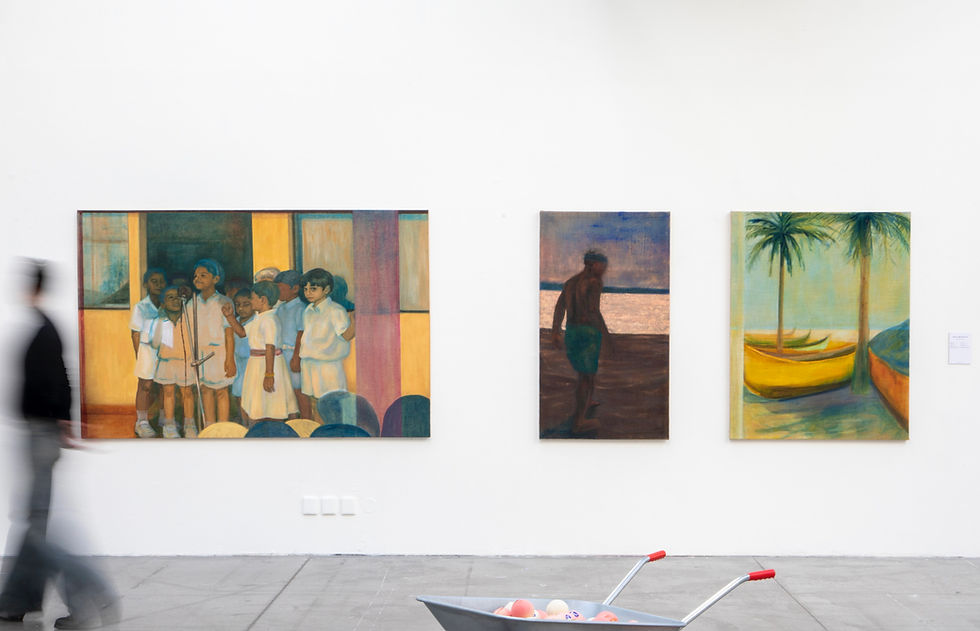
C-P: Hi Aaron! I have the great pleasure of working with you on an upcoming two-person exhibition at Nord Books and CRUM in Stockholm alongside fellow Konstfack graduate Berenice Hernández. What will you be showing?
A.B: Yes! I’m also really excited about working and exhibiting together. I’ll be showing a few new paintings that I have been working on. Lately I have been thinking a lot about the idea of returning to a place, either physically or through memory, and how that collides with a sense of distance. So these works that I'll be showing are the results of an attempt to confront or at least acknowledge that sense of distance within my own practice.
With these works I have started to introduce the grid as a structure into my practice, as a way of thinking about and relating to distance. The grid for me becomes a structure that disrupts and comes between the viewer and the image represented in the painting. Working with the grid has introduced new ways of thinking about flatness, disruption and materiality in my practice.
For me it's been interesting to think about the material quality of the grid as something physical that you can touch and how that relates to the present, the here and now, while the image of the painting stretches to a place far beyond. That push and pull that happens is something that really interests me.

C-P: I first encountered your work at your BFA degree show at Konstfack. Your visual world really resonated with me, as I also have roots in South Asia. Could you tell me a bit about your background, and your years prior to art school?
A.B: My mother is Swedish and my dad's from the southern state of India called Kerala. So when I was around four we moved as a family to India and stayed there until I was about 14. Growing up in Kerala was amazing, it's definitely shaped my thinking and how I see the world. As a painter it's had a huge influence on my visual language and how I see and think about colour and light. In 2017 I studied a year at Nyckelviksskolan before moving back to India for a few years. So I've constantly been moving between these two places. Coming from a multicultural home and having to navigate between these two vastly different places has made me face questions of identity and belonging that are deeply rooted in my thinking and art.
C-P: You use jute in your painting practice, a material that is quite rare in contemporary art locally, but one that carries childhood connotations for me. I can almost see that rice bag in front of me! Jokes aside, what draws you to it?

A.B: For me I love the materiality of jute! I love that it is quite rough and that it's loosely woven compared to typical linen or cotton canvases. It is hard on my brushes and consumes a lot of colour and paint which slows down the process a bit, but I like that it has that strong presence. For me, like you mentioned there is a familiarity with jute and it's quite nostalgic for me as well. Most of the jute that is produced comes from either India or Bangladesh and growing up it was super common to come across it on a daily basis in India. So that embodied history is also what’s drawn me towards using it in my practice.
C-P: In your process, you mostly depart from your own family photographs, right?
A.B: I’m not one of those painters that goes straight to the canvas. I usually have some sort of reference, however small or fragmented, that triggers some sort of memory or emotion that I then respond to. I’m very lucky that my grandmother was really good at documenting a lot of moments in the family, so I have found a lot of material to dig into there. However I would say that my sources vary a lot more now. Recently I have started sketching more which has become its own point of departure.
C-P: Unlike some of your peers, you decided to take a break after your BFA graduation before jumping onto an MFA programme. What went into that decision?
A.B: I had an amazing time at Konstfack, and I learned a lot over the last three years. I think I just felt like I wanted to take a year or two to process everything, work outside of the institution, and change my environment a bit. Having said that, I’m really looking forward to the MFA haha.
C-P: When I first saw your work, Peter Doig immediately sprung to mind, and I wasn't surprised to find a book of his in your studio. Which other artists do you look to for inspiration?
A.B: I resonate with a lot of Doig’s paintings. I think one of the reasons is because many of his landscapes remind me of Kerala. I draw a lot of inspiration from his colour compositions, and I look at Matisse in a similar way. He had an incredibly bold approach to colour that still feels quite modern, and to think he was doing it 100 years ago is really inspiring. But I’m inspired by a lot of contemporary painters, lately I’ve been looking more at Mohammed Sami, Emma Fineman and Michael Armitage.

C-P: With the year rapidly coming to an end, what are your plans for 2027?
A.B: In 2027, I’m planning to take part in two exhibitions in the spring. Beyond that, I’m keeping my plans open. I’m really happy to be at a place where I can work and I want to try to maximise that opportunity. My goal in the studio for 2027 is to work on a larger body of work, which hopefully I’ll get to present at some other point.
All images courtesy of the artist. Photo (1): Sara Rad.
Something Something About Fragments opens at Crum and Nord Books, Stockholm, on Nov 12, 2026.