


Cancer dance

Cancer dance Nadja Hjorton November 4, 5, 7 & 8, 2026
MDT, Stockholm
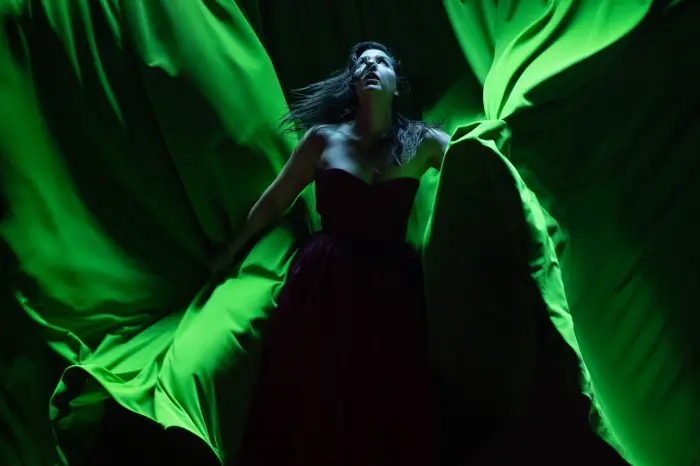
For her hybrid one-woman piece Cancer Dance, weaving together performance art, a theatrical framework and candid autobiographical stand-up and monologue, Nadja Hjorton, together with scenographer Chrisander Brun, notably alters the spatial perception of MDT into a register closer to Dramaten. Dramaten when it's optically banging, like the recent Das Kapital (which also saw Brun in the credits), or back in the day when Elverket was Dramaten's progressive and experimental stage and Sarah Kane was on the bill.
Dressed in a red debutante-like dress, Hjorton sets the stage in motion by abruptly but elegantly falling repeatedly in a sparse set, where the few elements, including her dress and an electric guitar, evoke, in the restraint of four colours, the Palestinian flag. When she picks the guitar up, in the sonic spirit of 90s Liz Phair and with the candor of unadorned Frida Hyvönen-style lyrics, she begins her narration through singing about finding out at a medical check-up that she has been diagnosed with breast cancer. Naturally, it's followed by an evident existential inquiry, which reads: Pourquoi moi? When she picks the guitar back up, the sonic landscape has shifted, becoming more brooding and moving closer to PJ Harvey, with a more subtly (self-)confrontational edge, led by: “I look cool in a buzzcut, I look like Sinéad O'Connor in a buzzcut.”
It's an impressive piece that, if you had to characterise it as one thing more than another, might actually come down to a musical monologue. At some point my contemporary art reference bank shoots to the once omnipresent Mika Rottenberg and her 2014 kinetic sculpture series Ponytails, with chunks of hair flipping and tossing around, coming out from holes in the wall. Not until now has the uncanniness of such frenetic hair-banging been this much of a hypnotic showstopper. Hjorton bangs away from behind a green curtain and, interestingly, it does not immediately appear to manifest frustration or dread, but rather signals some sort of acceptance or resignation to life throwing in a core-shaking curveball.
It's touching, it really is, to hear Hjorton share how she navigates the process and aftermath of something as harrowing as breast cancer, which affects one in eight women over their lifetime. I didn't hesitate for a second to get out of my seat for a standing ovation upon her calling it to an end. As much as she uses comic effect, and in that regard is served by comic precision in deadpan delivery, what makes her narration work is what makes the whole work work so very well. It's always measured, everything is economically wired, from her set, words and tone. She doesn't try to bridge limitations by overcompensating, where hybrid works like this, even when not necessary, jump into trashy or gaudy-looking DIY solutions. This author and her team know to edit, edit, edit. So what remains sounds good, looks good and reads well.
As for the musician name-dropping, I only later realise my old favourite, a brilliant lyricist who's been there for my heartbreaks and my heartaches growing up, Britta Persson, has been involved in the music department. It adds another smile to this face, rounding off this text.
Ashik Zaman
Concept & choreography: Nadja Hjorton
Lighting design & set design: Chrisander Brun
Costume & make-up: Daniel Åkerström Steen
Music composition: Britta Persson
Dance dramaturgy: Maryam Nikandish Production: Riksteatern