


Driscoll, Shechter, alone, together

flesh chariot, chariot of flesh
Cullberg
Kulturhuset Stadsteatern, Stockholm September 4, 2026; touring into 2027
Theatre of Dreams
Hofesh Shechter Company
Dansens Hus, Stockholm
October 1–4, 2026
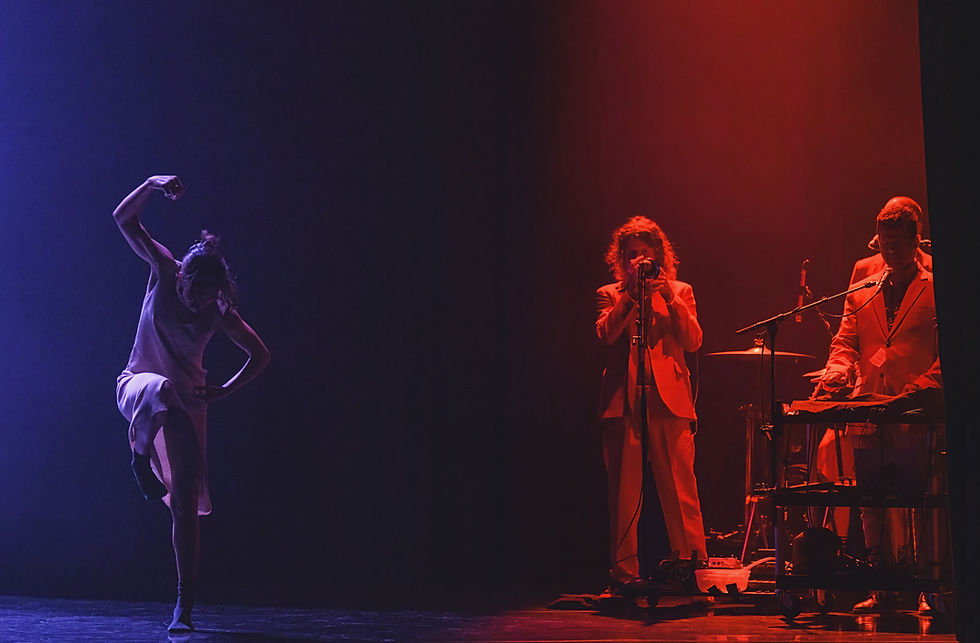
Two of too few gentle moments during choreographer Hofesh Shechter’s Theatre of Dreams are set to a song recorded in the 1950s by Nick Drake’s mother in her English home. Molly Drake’s heartbreaking, fragile “I Remember” starts with three verses. Each fondly recalls a different moment spent with a partner. Each ends with a punchline revealing how her experience was not, in fact, shared. In the end, Drake observes, her voice barely rising above languid piano notes:
The autumn leaves are tumbling down and winter’s almost here
But through the spring and summertime we laughed away the year
And now we can be grateful for the gift of memory
For I remember having fun
Two happy hearts that beat as one
When I had thought that we were “we”
But we were “you” and “me”
It’s apt and affecting, given that most of the rest of Shechter’s world-touring work is a barrage of stagecraft and movement by bodies who dance next to each other but not necessarily with one another. Created in part for the 2024 Cultural Olympiad in Paris, Theatre of Dreams squarely fits a trend pervasive in contemporary dance: plotless choreography for an ensemble of one, maybe two dozen who, subdivided into squads, move in lockstep around the stage. Each squad has its own phrases and gestural markers, often “contagious” in the sense that one person introduces the material, after which those nearby “catch” that material until everyone in the squad is “infected.” The squad then executes it in unison until its members disperse, or merge with another squad. (Few writers who’ve profiled Shechter have skipped the opportunity to mention his compulsory military service in Israel and, of course, the parallels between dance practice and combat training are evident everywhere from the pages of Apollo’s Angels to the scenes in Beau Travail.)
Soloists break free from these molds occasionally but never develop into characters, so it’s difficult to say whether anyone onstage is experiencing any kind of arc or change. There isn’t much duet material, what in dance is called “partnering,” some of the benefits being: it is much easier to shuffle dancers among the various roles, reconfigure the work less any injured or sick, and adapt the scheme to venues with stages of different sizes and shapes.
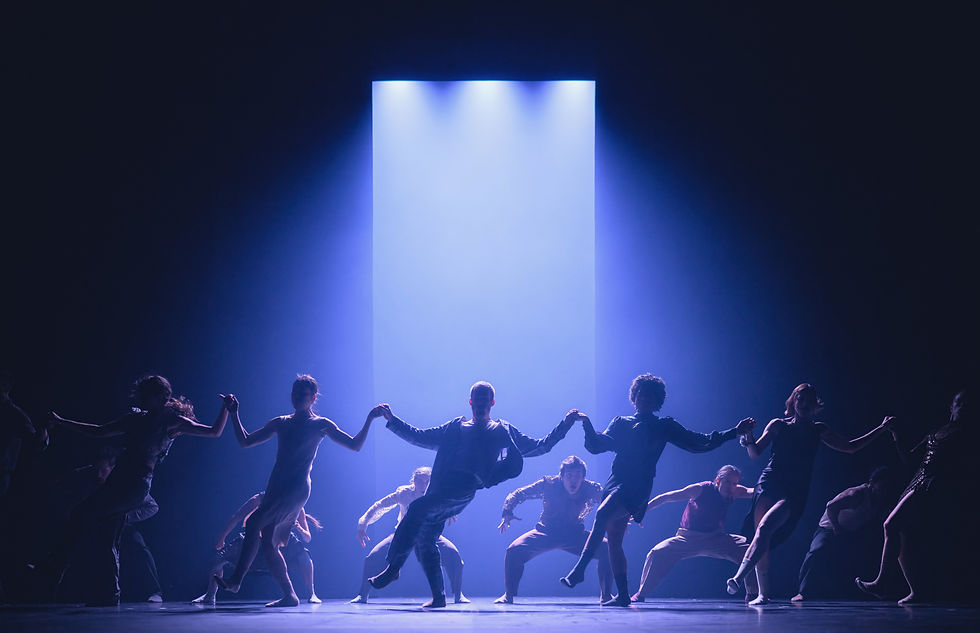
This trend sprang from more than one place but a primary source is in Tel Aviv. Shechter’s experience includes a period spent at Batsheva Dance Company, where artists learn a lot about generating movement material, perhaps less about composition, editing, and traffic patterning. Physical contact isn’t absent from works made by the Batsheva diaspora, but it does tend to be fleeting or quotidian. The performers hold hands, forming lines and rotating rings, or interact with each other in emotionally ambiguous or aggressive ways. Dance can redeem us by showing (or reminding) us how to be intimate with one another, how to handle each other with care, how to support and uplift one another. The most tender image in Theatre of Dreams might be of two dancers standing side by side, one’s head on the other’s shoulder, while “I Remember” plays. It’s a tableau. They don’t move. When the house lights come up and one performer says we should join in, we are not told to dance with each other, nor does anyone model that choice by pairing up.
Are these images of people alone together in Theatre of Dreams — and so many other recent works of choreography — a reflection of contemporary life, of our headphoned and tuned-out lives, of the silent disco of the everyday? Or are there other reasons why the extended dance duet fell out of fashion? It takes more time to create, troubleshoot, and refine partnered material; it can also involve more risk and be more physically dangerous. A few former dance colleagues who have transitioned into rehearsal direction and staging tell me that, at some academies and companies, it is increasingly difficult to find dancers who are confident at, and skilled in, complex partnering. That subset of dance training can be strictly gendered in ways harder now to negotiate and it all but requires instructors to demonstrate, i.e., to touch their students. While I can’t personally say I experienced anything during a partnering class in the mid ’90s that felt problematic or nonconsensual, far too many students absolutely, unfortunately did.

I wrote about intimacy coordination and direction for Dance Magazine more than five years ago. American choreographer Faye Driscoll was among my sources for that article. Her new work flesh chariot, chariot of flesh opened Cullberg’s fall season in Stockholm and is touring internationally into next year. It bucks this trend. Its lengthy, opening scene is a tight tangle of bodies unable to escape any other’s grasp for more than few seconds. They push and are pushed, pull and are pulled, lift and are lifted, all while slipping and sliding on a white sheet draped loosely over a platform and a pile of boxes. Danger, risk, and microphones hang in the air, amplifying the dancers’ heavy breathing and the varied sounds of bodily contact: smack, slap, thwack, thud. If there are any sequences of unison movement in flesh chariot, I don’t remember them.
The performers of flesh chariot would appear positively claustrophiliac if they made more than minimal eye contact but, because they act despite all their close interactions like they’re sharing an elevator, they come across just as disassociated as the figures in Shechter’s Dreams. One wonders whether Cullberg’s artists would prefer to be granted more breathing room, just as one wonders whether Shechter’s dancers might wish for longer-lasting embraces.
As in some prior works of Driscoll’s, those who perform flesh chariot are confined to a stage within a stage, a dais which both compresses the action and surrounds it with marginal emptiness, framing the intense proximity and impossibility of privacy as imposed constraints. In contrast, Shechter’s Theatre of Dreams employs low lighting, liberal amounts of theatrical haze, and nested layers of traveling curtains to make the stage seem dimensionally limitless. Each time two curtains part, they reveal yet another pair, raising one more question about what’s concealed or what will happen next. In the end, the dancers face a luxuriously draped, shimmering curtain far upstage as if, at long last, the real show is about to begin — but it never does.
Eventually, during flesh chariot, the knot of bodies comes apart and some source of suction upstage begins to consume the enormous, white sheet along with the few dancers left stranded on it, those who escaped the crowd only to cross an event horizon. Slowly, inexorably, the world we’ve been watching is swallowed away, out of existence. The end approaches — but it never arrives.
Neither work alone feels satisfying. Taken together, they show us a lot.
Zachary Whittenburg
Zachary Whittenburg has been a journalist, administrator, photographer, and grantmaker in arts and culture since 2008. A regular contributor to Dance Magazine and former dance editor at Time Out Chicago magazine, he has written for numerous additional publications including Critical Correspondence, Critical Read, Dance International, Flavorwire, Pointe, and Total Theatre UK.
• • •