


Exhibitions to watch in 2026

Updated: Jan 15
2026 is already up to a great start, and here's a selection of what will continue to make the first half of the year exciting.

Alina Chaiderov, Theta, Coulisse Gallery, Stockholm, 15.01–14.02.2026
Despite several international exhibitions to her credit and gallery representation with Ciaccia Levi in Paris and Milan, formerly Antoine Levi, Paris, Alina Chaiderov remained a hidden gem on the local art scene for years. In fact, it was a shock to realize at the time of her Art Basel Statements presentation with then Antoine Levi in 2018 that no gallery in Stockholm had yet brought her work forth. For the team, however, Alina has been one to closely monitor ever since graduating from Valand in Gothenburg over a decade ago, and since covering her cohort back then for our magazine. Following her last and first solo show in Stockholm, at Galerie Nordenhake, Alina is now set to present a show with Coulisse Gallery, currently one of the trailblazing galleries locally, with a fast-rising international presence. Will this be a good fit? We keep our fingers crossed, and in the meanwhile anticipate a delectable show with conceptually driven installations and pristine and inventive mixed media sculptural assemblages.

Karol Radziszewski, The Classroom, Moderna Museet, Stockholm, 31.1 – 12.4.2026. Curator: Hendrik Folkerts
We have followed Karol’s artistic practice over the years, encountering his work in numerous exhibitions and public settings in Warsaw, and meeting him during his Warsaw Gallery Weekend solo show Ali at his gallery, BWA Warszawa, in 2016. In 2018, C-print collaborated with Karol Radziszewski on a public, video-based exhibition that unfolded in the vitrine spaces of Mossutställningar, an early local encounter with an artistic practice concerned with visibility, desire, and the politics of looking. That long-standing engagement with queer histories and modes of address now finds a more expansive form in The Classroom, a reconstruction of a Polish classroom from the 1990s. Here, Karol Radziszewski brings together more than two decades of archival research into an immersive pedagogical environment, where desks, wall displays, and teaching materials function as carriers of narratives systematically excluded from dominant histories.Grounded in Radziszewski’s work with the Queer Archives Institute and the publication DIK Fagazine, The Classroom is put to work as a method for producing knowledge and dialogue. Activated through performances, talks, and a concluding film programme, the exhibition takes shape as a lived learning space, one we are looking forward to experiencing as a site where history is taught, questioned, and rewritten.

Inuuteq Storch, Rise of the Sunken Sun, Hasselblad Center, Gothenburg, 6.2.2026–3.5.2027
Greenlandic photographer Inuuteq Storch’s emergence into wider international view at the 60th Venice Biennale, where he represented the Danish Pavilion, could hardly be more timely, with global attention increasingly directed toward the island. In general, knowledge of Greenland, of the Indigenous Inuit people of Kalaallit Nunaat, and of the region’s contemporary art production has been limited, and it has rarely been connected to contemporary art discourse. Against this backdrop, Storch’s work, which opens a window onto both (de)colonial history and everyday life, feels particularly welcome. His photographic style is recognisable, yes, and bears clear kinships, yet the perspectives he offers remain novel to us, a quality that was also evident in the presentation of his work at the most recent Chart Art Fair in Copenhagen through his gallery Wilson Saplana, and which stood out as a takeaway for the team.

Harald Beharie, Sweet Spot, MDT, 14.2 –15.2.2026, Stockholm
When the award-winning Norwegian-Jamaican choreographer Harald Beharie, in spring 2023, performed his solo Batty Bwoy at MDT, it might very well have been the most “out there” piece we have ever seen at the venue. An electrifying grease-lightning moment, quite literally, with a performer fully and convincingly giving weight to the saying of giving it one’s all. A display of transfixing an audience while pushing its buttons through precise and self-possessed choreography, emulating a state of visceral trance. Described as an examination of the absurdity of queer monstrosity, Batty Bwoy used dance to confront and embrace fears of the queer body as perverse and deviant. Sweet Spot, opening at MDT around Valentine’s Day weekend, marks the third entry in a trilogy that also includes Beharie’s 2024 piece Undersang. We think we’re ready for this “seductive hellmouth” of dancing mischief.
Also, on the note of MDT, we are expecting another knockout by BamBam Frost this spring. Currently enrolled at the Royal Institute of Art, BamBam has been on our radar ever since her collaborative work (immortal summit) with Lydia Östberg Diakité presented at MDT back in 2021 (notably made our best list said year). BamBam returns to MDT in March with up up up, the third installment in an ongoing work which will be performed by second year students in Choreography at UniArts.

AI and the Paradox of Agency, group exhibition, Bildmuseet, 13.3. 2026 –17.1.2027, Umeå. Curators: Sarah Cook and Katarina Pierre
Bildmuseet in Umeå is a singular museum up north, presenting a singular exhibition programme that continuously manages to set itself apart from museums and art spaces of similar pedigree in Sweden’s three premier cities. It’s not that there are never any overlaps in artists or approaches, but there is a lens through which it operates that seems very alien and distant from a provincial penchant that is more evident elsewhere at other venues. The museum, at face value, often appears to take its cues rather from biennials in the Global South and contexts like the Kochi-Muziris Biennale and the Sharjah Biennial than from locking down the standouts of the Venice Biennale. If you know what that means, you know. So when the museum presents an AI-scrutinizing exhibition prefaced with the question, Who holds the power when AI enters our lives?, curiosity is piqued as to what the outlay will be. At some other institution’s hand it would be more predictable, but here the art set list, where Indian trio Raqs Media Collective, who have had liaisons with Bonniers Konsthall in the past, make for the more known names, creates more of a clean slate, giving incentives to be intrigued. Will it be a feat, and the timely and potent exhibition we all could do with, with enough weight to paddle us through to the next iteration or phase of exhibitions themed this way?

Luna Lopez, Galleri Cora Hillebrand, 20.3 - 19.4.2026, Gothenburg
Sweden suffers from a certain twisted Peter Pan complex, a reluctance to grow within contemporary photography. Or perhaps this is more true of the gatekeepers, who continue to perpetuate space and visibility for the same artists they championed 10–15 years ago. It’s tiring, and strange, given that HDK-Valand in Gothenburg produces a string of gifted lens-based artists each year. We remember Cora Hillebrand as a graduate of the school circa 2015, though she appears since to have fully transitioned into a gallerist, and an important one for the makeup of the Gothenburg gallery scene. Luna Lopez is a visual artist who was shortlisted and featured in our first print magazine issue, The Future Watch Issue, as a next-generation artist. Her style is reminiscent, yet in an art scene where both peers and the generation before seem entrenched in a gaze tinged with the provincial, her lens feels nimbler and unbordered. Her career trajectory is closer to that of Roe Ethridge or Collier Schorr, as she moves fluidly between commission, fashion, and the sockets of fine art. We’ve previewed samples from her upcoming exhibition, for which she has partly followed two MMA practitioners. It’s giving Heated Rivalry.
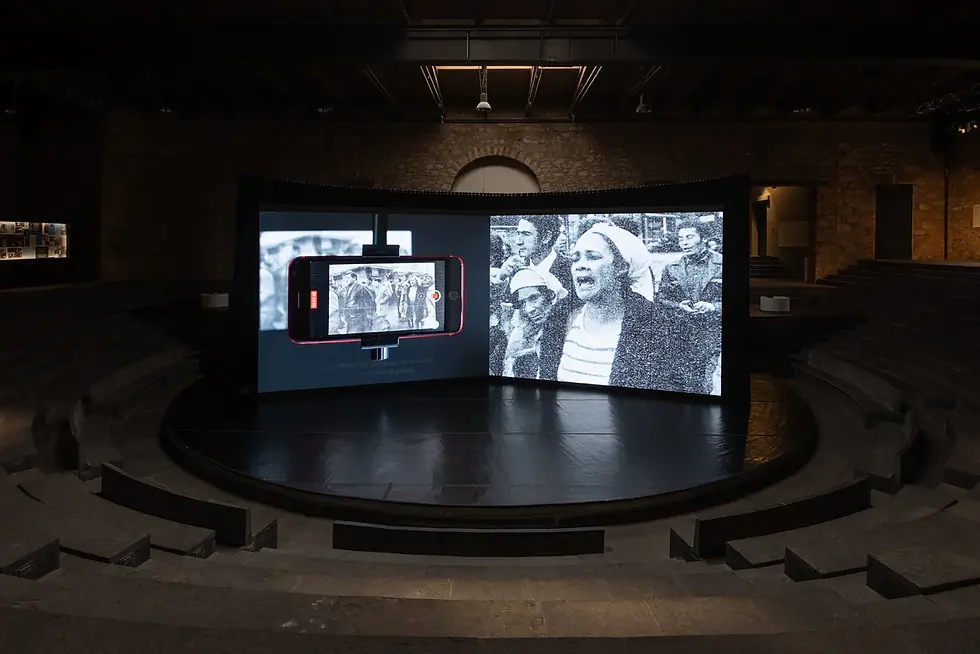
Bouchra Khalili, Malmö Konsthall, 6.6 –13.9.2026, Malmö
Bouchra Khalili will be presented at Malmö Konsthall in June in what will be her largest exhibition in Scandinavia to date, and her first in southern Sweden. Living and working in Vienna, the Moroccan-French artist is known for a film- and video-based practice that centers storytelling as a political tool, addressing questions of belonging, community, and democracy. The exhibition brings together works from the early 2010s to the present, including The Tempest Society, The Circle Project, The Public Storyteller, and her most recent film, The Public Scribe. Through first-person narration and collaborative methods, Khalili gives space to voices rendered invisible by the nation-state, forming a collective narrative rooted in lived experience. With Bouchra Khalili, memories shoot back to solo exhibitions at Färgfabriken in Stockholm and the Secession in Vienna in 2016 and 2018, respectively. Admittedly, we missed her work at the last Venice Biennale, and are eager to dive into this survey, which brings us up to speed with her more recent works.

Additionally:
Spring obsession: Industry, season 4, streaming weekly on HBO Max
It’s interesting to think about how the once chilly-lensed and intentionally Brit-bleak Industry went from a more obscure and seemingly niche HBO offering across its three completed seasons to, through word of mouth, becoming a buzzy, compulsive watch now hailed as a successor to Succession. Yes, the show has undergone an evident metamorphosis from when its protagonists were Young Turks in a cutthroat, dog-eat-dog, painstaking trading and hedge-fund capital world of London, fighting to find their footing in the pecking order, to now being at the helm of their conspiring reigns. It’s modern-day Shakespeare at its most pleasurable. It’s a show that forces you to submit, much like the action playing out on screen. Most of us have no real clue about the lingo coming out of our favourite characters’ mouths, which can be frustrating at times, but it only highlights the strength of the acting and performances, which more than compensate for the lack of control over what we’re investing in. Season 4 is off to an explosive start right out of the gate. Wild!
Ashik & Koshik Zaman and Kasia Syty
Team C-print consists of curators Ashik and Koshik Zaman, who founded C-print together in 2013. Ashik Zaman serves as the artistic director of Konstnärshuset in Stockholm and is a board member of Konstnärsnämnden. Koshik Zaman is an independent curator, and they are both regular contributors as critics to the international lens-based art publication Camera Austria.
Kasia Syty is a film critic, culture journalist, and translator specializing in film and contemporary culture. She has worked as film editor at Nöjesguiden and as a film critic for Upsala Nya Tidning and Filmrutan, among others. In 2023, she received the Filmpennan, awarded by Filmpublicisterna (the Swedish Film Publicists Association), in recognition of her ability to combine unexpected references with sharp cinephile observation and a distinctly personal critical voice. She has also served as artistic director of Bergman Week and as programme coordinator at Bio Aspen.