


Freddy and men/ding


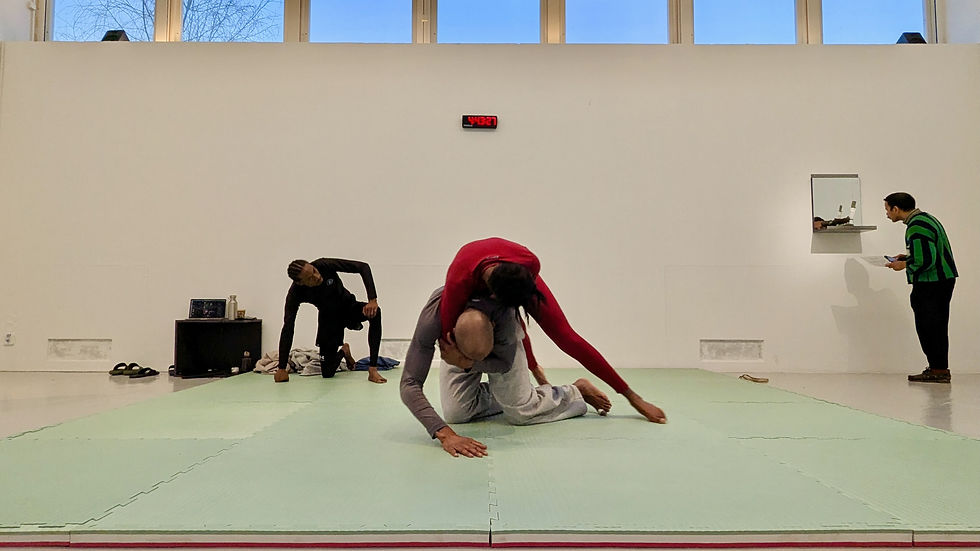
Two seminal artists in particular come to mind where wrestling and BJJ are concerned, prefaced by an attention to masculinities, just as is the case with emerging French-born artist Freddy Houndekindo, who is graduating this spring with an MFA from the Royal Institute of Art in Stockholm. One is, of course, American photographer Collier Schorr and her photographs of wrestlers that, rather than focusing on dominance or the spectacle of combat, emphasize fragility, tenderness, and intimacy. But a much closer kin, looking at his graduate exhibition men/ding, which just ended its run, is another French artist, Camille Henrot, who specifically looked at BJJ and drew parallels between the sport and the grooming of racehorses. In doing so, she highlighted how combat sports and the training of racehorses reveal arguably less vocalized forms of tenderness and sensual intimacy between bodies. Like Henrot, Houndekindo brings forth a spatial setting where readymade fixtures and iconographies from mat rooms are incorporated, sharing space with more abstracted sculptures and his own forms and shapes that begin to disrupt the direct, literal, and depictive nature of the space, creating a more artistically compelling and suggestive environment. It’s a thought-provoking idea that the his graduate work puts forward, that practicing close-contact combat sports both affirms and “rejects” stereotypes of heteronormative masculinities. On the one hand, ideas of males as physically able defenders, protectors, and warriors, etc., are perpetuated, but on the other, consensual and non-sexual homoeroticism often emerges through contextual intimacy and close touch, contradicting heteronormative and stereotypical masculinities.
For practitioners to vocalize this dichotomy themselves, even if it may feel too close for comfort, rather than leaving it to bystanders or the external gaze, could offer nuance and help anchor a broader register of masculinities “directly on the mats.” As there is a troubling resurgence of toxic masculinities, men/ding feels especially relevant as an exhibition.
Here is an interview we carried out with Houndekindo as he was in the final stages of materializing his graduate work, which will soon be shown in another iteration at the collective spring MFA exhibition in May.

C-P: You are a trained dancer and choreographer with an early background in combat sports and wrestling. How has this shaped your approach to artistic work?
F.H: It’s been a full-circle story. I grew up wrestling; together with my sibling, we went through sports studies at least until middle school. Around that age, I got into a brawl and was injured, and that’s when I discovered dance and quit wrestling.
A few years ago, I found myself in a difficult situation, feeling abused and helpless. As a dancer, I felt like my body wasn’t mine anymore. In reaction to that, I started training again, reclaiming my body, its identity, and a sense of integrity, which set me on a new artistic path. Dance and sport both stem from embodied forms of knowledge, rooted in practice. My work emulates that reality: performance not as spectacle, but as a form of labor to recover the self. Over the last three years, I have created a body of work centered around combat and contact sports as a site to investigate masculinities, violence, and intimacy.

C-P: What has this ongoing transition been like, from collective production in the world-renowned dance company Cullberg, to this individual position within visual art?
F.H: As a dancer at Cullberg, you’re intrinsically a support for guest artists’ ideas; your body is literally a vessel for their practices, aesthetic preferences, and ways of seeing. After six years, I felt the need to pause and give myself time to distinguish what is mine and integrated, and what is merely reminiscent of someone else’s work. It’s been delightful to notice how the core of my practice, even buried under layers of influence, has remained the same. The reason I moved toward visual art is that I wanted more access and more support to work as an interdisciplinary artist. What I am learning through the master’s program in fine art at Mejan is a new grammar, a different way of articulating my artistic discourse, alongside gaining institutional legitimacy.
C-P: Recently you have been activating the traveling exhibition When We See Us, which highlights a century of Black figurative painting, at Liljevalchs in Stockholm through expansive choreographic performance. Tell me about engaging with existing works this way, and "interpreting" and responding to art through bodily movement.
F.H: It is a privilege to have such an immersive and interactive dialogue with When We See Us. It gives me the opportunity to connect with my cultural ancestry in ways that are quite unique. The performance Becoming Tree is an invitation into a performative guided walk where my personal stories are interwoven with anecdotes about the works and the exhibition’s thematic rooms. Paced with musical interludes and spoken-word poetry in French, Fongbe, and English, I try to give the tour-performance a three-dimensionality, allowing the audience to understand Black creative production as a holistic practice.
To mimic organic cycles, I perform monthly for the entire duration of the exhibition. That extended duration anchors performance in a different temporality in relation to the visual art context and gives me the possibility to excavate more stories, as well as speculate further about life on the continent.
C-P: Given your interest in scrutinizing stereotypical and heteronormative masculinities, what insights do you intend to bring forward?
F.H: Through the work of bell hooks, I found a language to name some of my experiences as a Black man. Further down the road of masculinity studies, I realized how flawed and gaslighting the expression “toxic masculinity” can be. Its structure defaults to rendering all men faulty and all masculine gestures toxic, while making “unmanly” gestures invisible and precarious. Masculinities intersect with race, class, sexuality, and nationality; they are dynamic and contextual. I’ve created a meme account on Instagram centered on contemporary masculinity: @moods_of_manhood. Through my work, I focus on the study and expression of intimacy. I found sport to be the perfect ground to observe how intimacy is performed without being sexualized.

C-P: Lastly, what would you like to share about your work this spring as you approach graduation from the Royal Institute of Art?
F.H: I literally have a few ceramic works ready to be fired; I’ve found this material to be akin to my way of working. Ceramics are a time-based medium, very much like performance. Besides that, I am working on a performance installation for my solo show at Galleri Mejan, involving multiple guests, including my siblings, as well as a choreographic installation at Konstakademien. Together with 16 pre-professional dancers from the bachelor’s programme in Dance at Stockholm University of the Arts, we will inhabit the academy with a study of intimacy through the aesthetic of violence. You can also see my solo work during Weld’s 20th anniversary and the STHLM DANS Festival.
Ashik Zaman