


Into the hall of mirrors with Alexander Ekman

Hammer
GöteborgsOperans Danskompani April 24–26, 2026
Dansens Hus, Stockholm
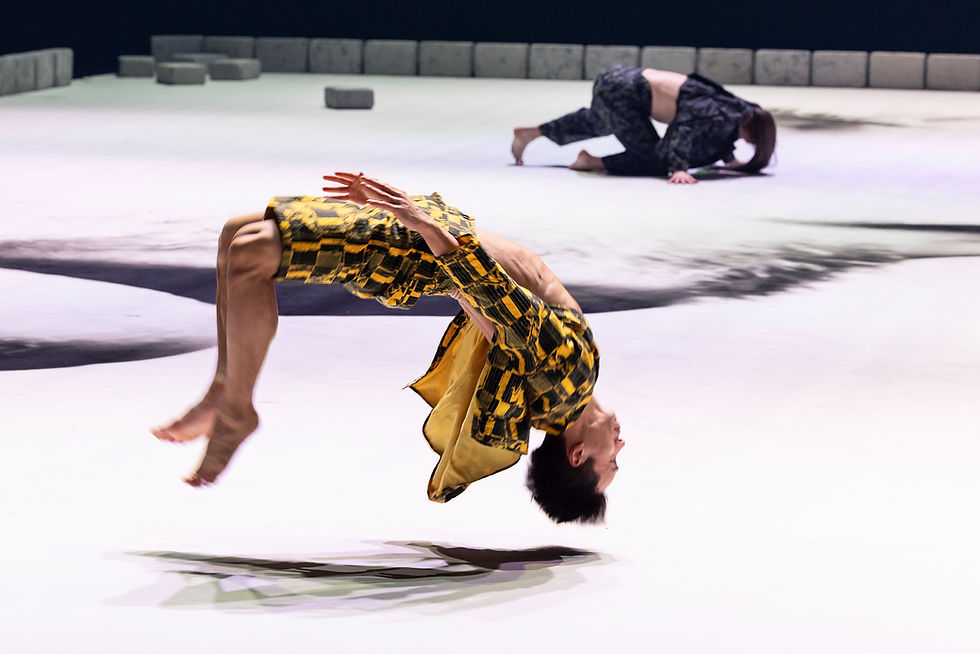
Celebrated choreographer Alexander Ekman’s third creation for GöteborgsOperans Danskompani premiered three and a half years ago and is back on stages this spring. The ensemble’s current tour includes venues in Austria, Finland, France, Germany, Spain, and Switzerland, in addition to last week’s run at Dansens Hus. Ekman’s Hammer is one of more than a dozen works in active repertoire at GöteborgsOperans; many others are by choreographers just as recognized and rewarded as Ekman is. Few ensembles on Earth are capable of embodying such a broad spectrum of movement qualities, of being fluent in so many different techniques (and languages, as the dancers represent more than 20 nationalities). It must be noted up front just how accomplished, powerful, and especially versatile these artists are.
These facts are evidently not secrets. Dansens Hus was packed to the rafters. (I and many others sat on portable stools behind the last row of fixed seating.) Some might’ve already seen the 2023 film version of Hammer, by go-to dance cinema director Tommy Pascal, broadcast and made available for streaming. Hammer is a verifiable hit and its Stockholm audience was amped — and dressed — for the occasion. Amidst accusations of irrelevance or “just questions” about the need to support culture and the arts, it felt good to be in a sold-out house crackling with the anticipation and energy of an arena concert, yet for contemporary dance.
The subject of Hammer is today’s toxic cocktail of imagery, insecurity, technology, and vanity. The first act introduces the titular gavel, painted safety orange. For much of the show, it hangs high in a shallow tray, an oversized “break in case of emergency” tool. (Maybe it’s the Hammer of Damocles for looksmaxxing influencers.) Dozens of soft-edged, grey boxes at the perimeter of the stage are like sandbags keeping floodwaters out. For the first act, one black-and-white photograph completely covers the stage surface: two faces in profile, their foreheads tenderly touching. Real intimacy — an offline, physical connection.
Ekman is a choreographer who absorbs and leverages what his lauded peers do best, without it seeming like plagiarism. He is immensely skilled at making non-narrative performance that feels just as full of the sweep of life as an epic film or a classic play. He does this in part through his canny understanding of how to mix preexisting stage languages into his own bespoke blend, for example: The scenes that bookend Hammer look much like the roving mannequins in lockstep unison that populate Sharon Eyal’s half-alien worlds. The jovial section that follows, with its colorful costumes and diversity of movement qualities, shares a free spirit with Justin Peck’s visions of community and youthful optimism. A rollicking, onstage talk show cohosted by “Lars and Larry” at a desk, facing cameras, has the Brechtian reflexivity of Crystal Pite, with two-dimensional props that look almost lifted from Le Sale ka Kgotso, Lebohang Kganye’s superb exhibition on view at Fotografiska.
Hammer includes both that photographic floor and full-height video projections like an Ivo van Hove production, plus a stretch of movement by seated dancers that echoes Anne Teresa De Keersmaeker. Ekman has a way of introducing and resurfacing a symbol pregnant with different associations for different viewers — a table, a hat, a hammer — that’s very Mats Ek. He borrows William Forsythe’s way of using one dancer’s unexpected entrance to interrupt and reframe an entire stage picture. Some of Joakim Brink’s lighting choices carry whiffs of works by Pina Bausch, while the mirrored surfaces and simmering anxieties at the top of Hammer’s second act are a deeper cut: Paul Taylor’s sociological investigations, e.g., Cloven Kingdom (1976) and Last Look (1985). All of which isn’t to suggest that being at an Ekman show is like watching everyone else’s shows for a second time. Again, he brings these various strategies of stagecraft together, into rich conversation, about specific subjects, to create a whole that’s more than the sum of its parts.

Because Hammer is so much a warning from the edge of the abyss — the endless, rapacious cycle of capture, imitation, and replication — these layers of references work with, instead of against, its plea to unsubscribe. The boxes upon which many dancers sit after the interval are reflective, as is the floor after a horde of dancers peels off its top layer. When another black-and-white close-up of a face, this time on video, appears upstage, the Doppelgänger staring back up at him is an obvious nod to Narcissus. (This profile slowly descends, then extends its tongue to lick the shiny surface.) Everyone at one point is wearing all black with sunglasses and chunky boots, like agents in The Matrix or bar-hoppers on Södermalm. Everyone then changes into oversized, faux-fur coats and orange wigs, their jaws wrapped with bandages, perhaps after elective surgeries. (Henrik Vibskov’s costumes, somewhat gimmicky in the back half, are nonetheless gorgeous in the first act.) Two dozen–some dancers even crawl off the stage and into the audience, flowing like warm honey uphill, before posing for photographs and borrowing delighted attendees’ phones to take selfies. In less-capable hands, such big swings and interactive stunts could be insufferable or simply a mess, but Ekman orchestrates it all as confidently as he models ribbed underwear for CDLP. Most incredibly, the transitions between all these environments actually work, sometimes by continuing the movement “text” of a section while changing the “font,” if that makes sense. The compositions are absolutely symphonic, full of mindfully managed ebbs and flows and sprinkled with surprises. Hammer is show business, pristinely executed.
Mikael Karlsson’s terrific score makes the waves that keep all this restless, varied action afloat. Plucked bass lines become slack breakbeats until bright trumpets break through, then piano lines gather momentum until it sounds like the entire building might leave the ground. Karlsson and Ekman have made a great team for years now. It’s apparent they have a real, human connection.

Zachary Whittenburg
Zachary Whittenburg has been a journalist, administrator, photographer, and grantmaker in arts and culture since 2008. A regular contributor to Dance Magazine and former dance editor at Time Out Chicago magazine, he has written for numerous additional publications including Critical Correspondence, Critical Read, Dance International, Flavorwire, Pointe, and Total Theatre UK.