


Seasons change, cycles continue

Il Cimento dell’Armonia e dell’Inventione
Rosas A7LA5
Dansens Hus, Stockholm
March 24–25, 2026
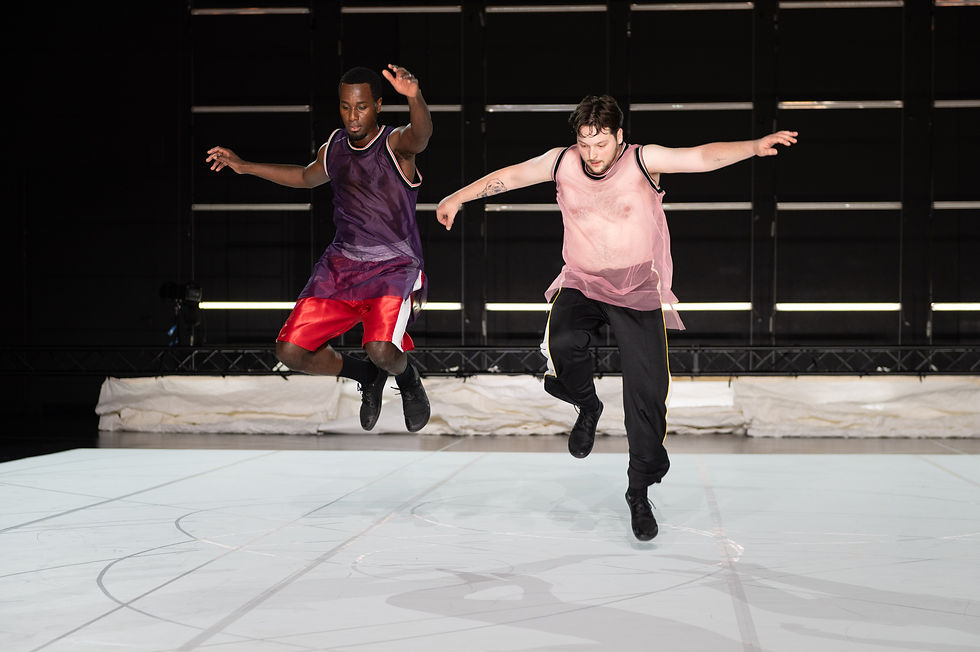
It is one thing to be impressed by intermittent flashes of daring and virtuosity, suspended in a solution of readily available patterns and tropes. It is a different thing to be trusted to gather and connect the dots sprinkled before you as time passes. I expect one reason why fans are so consistent in their support of touring dance company Rosas — amidst good news, and bad, about the Brussels-based ensemble — is that its shows feel like rewards for caring deeply about dance. They can also be enormously successful at audience development, just as accessible to those who don’t identify as dance lovers at all, a quality that cultivates its own kind of loyalty. For both types, what they see might be recognizable yet recontextualized or given new meaning. People like being assumed to know enough already to appreciate what’s in front of them, and they’ll come back for more of that affirmation.
You might call such a flattering, fresh take on the familiar “a contest between harmony and invention” or, in Italian, il cimento dell’armonia e dell’inventione. Antonio Vivaldi employed that phrase as the overall title for twelve concerti, of which the first four are his famous odes to the seasons.
As inspiration for a second collaboration between Rosas founder Anne Teresa De Keersmaeker and a former student, Radouan Mriziga (A7LA5), Vivaldi’s stagioni have not been decoupled from the poems he probably wrote along with the concerti. Il Cimento dell’Armonia e dell’Inventione theatricalizes lines from the sonnets as much as it visualizes and toys with Vivaldi’s music. (Before dance, De Keersmaeker studied flute, and violinist Amandine Beyer is credited as an analyst on the project.) Throughout the piece, we hear the four dancers chirp like augelletti in springtime, tornando ancora una volta al loro incanto canoro. In autumn, when this particular, annual cycle begins and ends, i cacciatori all’alba cacciano con corni, moschetti e cani. We hear the four dancers yip and and bark like hunting dogs, and we see them pantomime raising rifles to aim and fire at game. During the winter section, we see two of them battere i piedi to keep warm, transliterated to a crowd-pleasing, a cappella duet that alludes to gumboot and tap.
Another note present in the perfume of this mostly masterful chamber work — a quartet performed by a quartet, inspired by another pair of quartets — is N.N.N.N., William Forsythe’s 2002 étude on breathing, also for four men in streetwear, who also create mesmerizing systems of movement in silence. A third reference might be the “unstable molecular structures” Trisha Brown made in collaboration with, among others, Laurie Anderson, Donald Judd, Fujiko Nakaya, and Robert Rauschenberg.
What Il Cimento shares with Brown’s works from the early 1980s is the confident touch of an expert producer at the faders of a sound board in a recording studio. As the cycle unfolds, De Keersmaeker, Mriziga, and the four dancers balance complexity with simplicity, idiosyncrasy with unison, humor with seriousness, representation with abstraction, and exertion with rest. While on the sidelines, the four wipe sweat from their brows, gulp water from bottles, and playfully banter with one another like squash players between rallies. Sometimes, the four change garments for purely practical reasons, for example: breaker Nassim Baddag, who puts on a sweatshirt with long sleeves to downrock without burning the skin of his arms. Other costume changes align with compositional choices, for instance: all four men at one point wear sheer shirts with hoods, each silkscreened on the back with an image of a different bird. One wouldn’t be surprised to find the show’s fine mesh tunics and robes, designed by Aouatif Boulaich, at Comme des Garçons.

It is au courant for contemporary choreography to honor dance as physical labor. Earlier this season at Dansens Hus, we saw another Belgian artist, Miet Warlop, refrain similarly from any pretense of ease. Il Cimento is just one example of how the aesthetics of dance and sport have converged. Twenty years ago, David Foster Wallace wrote about Roger Federer as a movement artist; three hundred years after Vivaldi published The Four Seasons, it scores four dancers in basketball shorts, striding proudly in black tennis shoes like courtiers at court. Elsewhere in Stockholm, Cullberg alumnus Freddy Houndekindo is focused on wrestling practice as performance and Brazilian jiu-jitsu. Next up at Dansens Hus, Mette Ingvartsen platforms skateboarding.
De Keersmaeker and Mriziga’s lighting scheme for Il Cimento can be described as a monumentally scaled audio equalizer, with parallel columns of indicators that react in real time to the strength of frequencies on a spectrum. The show begins in silence; we watch these lights flicker and flash toward a visual crescendo of some impenetrable code, until Boštjan Antončič appears to perform a lengthy, gestural cadenza. Surprisingly and so beautifully, the lighting pattern repeats in retrograde as a coda to the entire evening, but this time we see that it visualizes the sound of a voice reciting lines from a poem by Danish-Somali artist Asmaa Jama.
Only in these final moments, after all of the dancing is done, does Il Cimento make explicit its warning: that we will only have seasonal cycles for as long as we can keep runaway climate change on a leash. As Jama writes in “We, the salvage”:
i caused wildfires — forgive me i am trying to salvage the soil now i am trying to stop it from becoming a cemetery
Zachary Whittenburg
Zachary Whittenburg has been a journalist, administrator, photographer, and grantmaker in arts and culture since 2008. A regular contributor to Dance Magazine and former dance editor at Time Out Chicago magazine, he has written for numerous additional publications including Critical Correspondence, Critical Read, Dance International, Flavorwire, Pointe, and Total Theatre UK.