


Wrestling with dance


Sport, Athleticism and Masculinity
Freddy Houndekindo, Girish Kumar Rachappa June 6, 2026 Centrum för fotografi, Stockholm
Armour
Heart Core September 5, 2026
Kulturhuset, Stockholm
The Water Roared in Sullen Waves
Rūdolfs Gediņš, Āris Matesovičs November 6 and 7, 2026
Konträr, Stockholm
The prevalence this year of wrestling presented in (or as) performance came as no surprise. Business tycoons, media mouthpieces, and political leaders grapple with each other daily in public life. This fall brought a rapid succession of elections, each framed as a fundamentally existential choice for the deciding nation, with implications for communities far beyond its borders. Legal arguments based on the merits are too often boiled down to battles of sheer will, through which language is devalued, rendering judgements perpetually contestable if not moot. Brute force is the new strategy, with agentic AI as its multiplier. There was an Ultimate Fighting Championship on the South Lawn, then a “joke” that UFC’s president and CEO would become the next White House press secretary. The victor takes it all or, rather, whatever can be salvaged afterwards.
There is, of course, a certain intimacy and homoeroticism to all this aggression and counter-posturing. Dance artists are generally more honest about that. Slop videos and petty name-calling grow tiresome fast, in part because the projection and self-repression that fuel them are so plainly self-evident. When a match leans fully into the performance it is and surrenders what Işıl İlkter calls “the familiar ending of defeat,” everyone gains a much better chance of winning something.
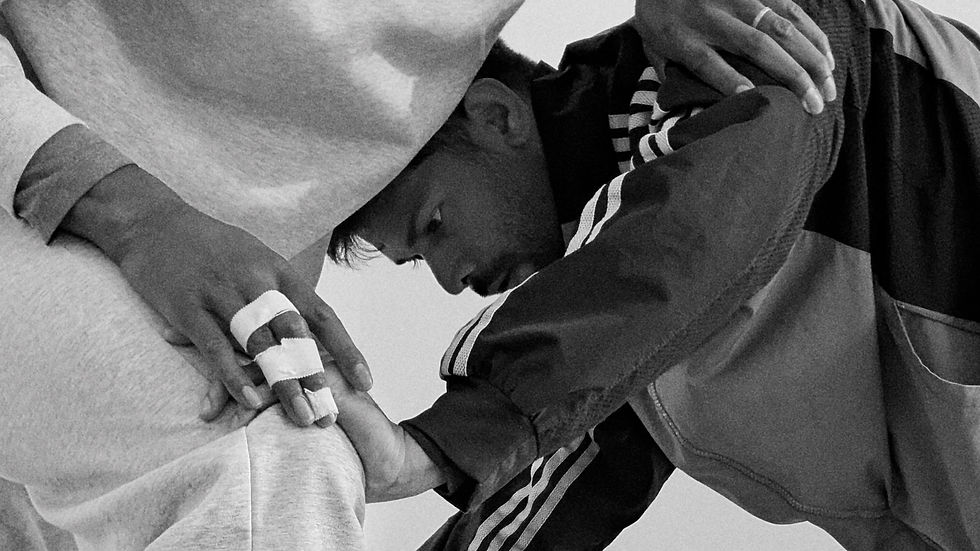
In June, following his MFA exhibition at the Royal Institute of Art, Cullberg alumnus Freddy Houndekindo dance-wrestled current ensemble member Girish Kumar Rachappa amidst Carl Ander’s Static Motion, a collection of images from health and sports instruction manuals. In divorcing photos labeled “Don’t” and “Fel” from their counterparts demonstrating proper posture and technique, Ander liberated those models from serving as illustrations of failure. Similarly, Houndekindo and Rachappa’s methodical sparring, careful and constantly consensual, pivoted their encounter from goal-oriented toward a mutually beneficial exploration of physics. Through adjustments to pace and intention alone, without altering the frame or the movement text, they transformed the mechanics of conflict into expressions of growth, humility, and even support.

Armour was a more theatrical and explicitly queer trio whose ongoing tour hit its 50-performance mark in Stockholm in September. Starring alumni of Un loup pour l’homme (Arno Ferrera), Jan Fabre’s Troubleyn (Gilles Polet), and Compagnie Gratte-Ciel (Jean-Daniel Broussé, in for original cast member Charlie Hession), Armour was a similarly slow burn, with wide margins of repose around its bold provocations. Most memorably, the men used gym chalk for a no-slip grip while they leaned backward at counterbalanced angles, grabbing each other quite literally by the balls. Staged arena-style in the round, Armour developed an intermittent structure, its acrobatic wrestling sections alternating with fraternally friendly or suggestively sexualized encounters. The bonds among the men seemed genuine and proposed a more sex-positive, psychologically durable form of masculinity, to those willing to exchange their insecurities for it.
To wit, program notes for Armour quoted the late, great writer bell hooks: “To know love, men must be able to let go the will to dominate. They must be able to choose life over death. They must be willing to change.”

Even further along the spectrum from movement study to physical psychodrama, The Water Roared in Sullen Waves took its inspiration from the last sentence of the epic poem Lāčplēsis by Andrejs Pumpurs, itself based on medieval Latvian legends. At the end of that story, the hero Lāčplēsis and a dark knight tumble into the Daugava River, where they are trapped together in an eternal struggle. Artfully staged with blue lighting and costumes on a multilevel set entirely blue (save one yellow door), the work was an explosion of that single line of prose into a cycle of unresolved competition landing somewhere between Franz Kafka and David Lynch.
Fiercely committed performers Rūdolfs Gediņš (also the director-choreographer) and Āris Matesovičs held nothing back, throwing themselves at one another and each other across the set, perfectly timed sound effects amplifying their blows. “Movement never lies,” said Martha Graham, twice as true when an error of timing or preparation could mean a broken back or neck. Kudos to Sergei Fyodorov, who served as wrestling coach to Gediņš and Matesovičs. I’m still metabolizing what the show’s final scene implies in light of the source text, which foretells the eventual triumph of Lāčplēsis over the dark knight. Does their becoming a hybrid creature suggest there is neither domination nor submission, only synthesis?
These were just three examples that happened to land in Stockholm this year. Madrid-based group Kor’sia’s project HUMAN was part of a C-print exhibition at Riksidrottsmuseum four years ago; there’s a screening of caner taker’s performance KIRKPINAR on December 5 in Berlin as part of Between Bridges, following a November 28 movement workshop informed by the artists’ research of self-defense. The bell rings. The fight continues.
Zachary Whittenburg
Zachary Whittenburg has been a journalist, administrator, photographer, and grantmaker in arts and culture since 2008. A regular contributor to Dance Magazine and former dance editor at Time Out Chicago magazine, he has written for numerous additional publications including Critical Correspondence, Critical Read, Dance International, Flavorwire, Pointe, and Total Theatre UK.